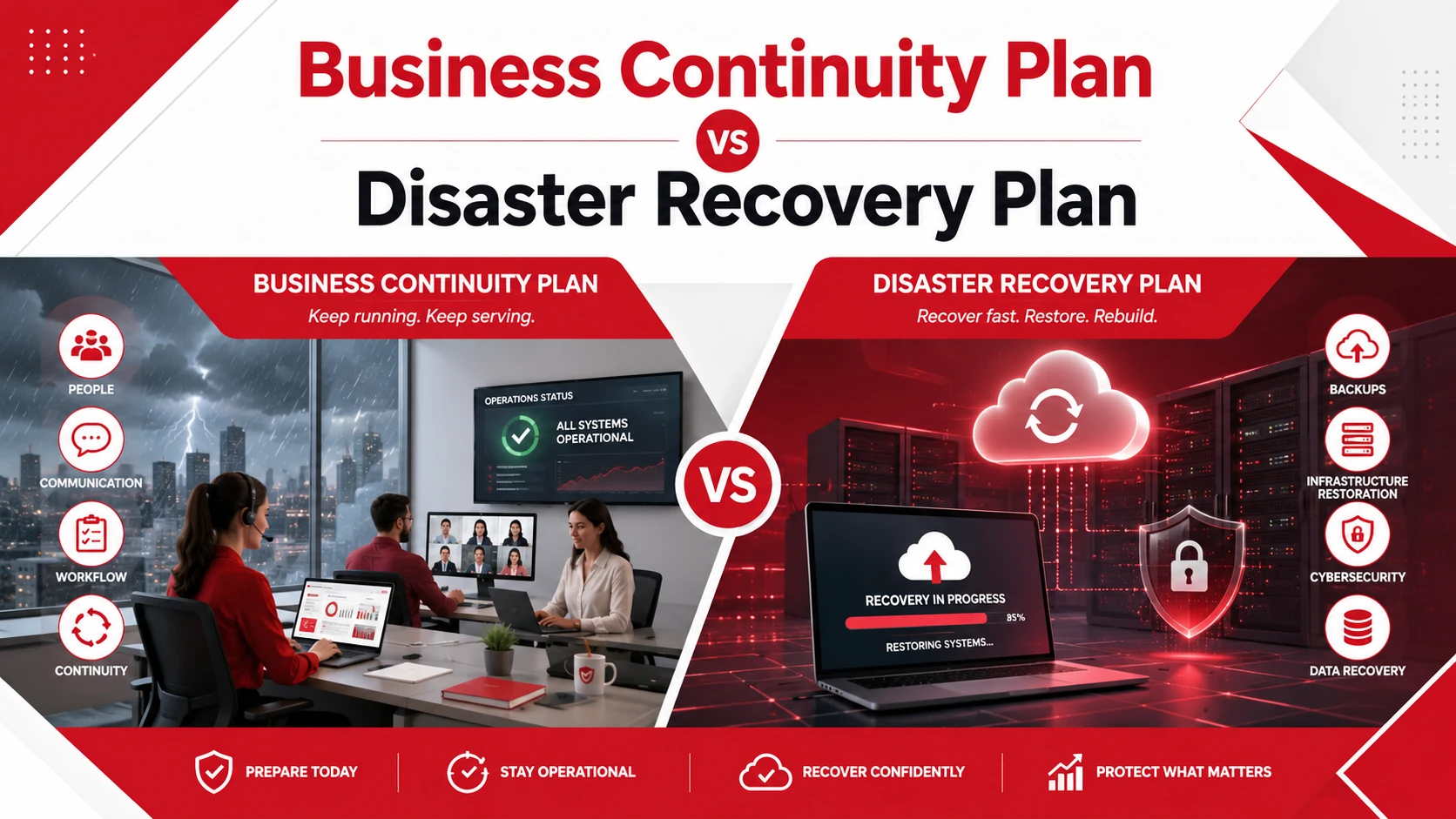
A business continuity plan explains how your business will keep operating during a disruption. A disaster recovery plan explains how your business will restore IT systems, data, applications, and infrastructure after a disruption.
Both plans are important, but they are not the same. Business continuity focuses on keeping essential operations running. Disaster recovery focuses on restoring the technology that supports those operations.
Key Takeaways
- A business continuity plan helps the business keep operating during disruption.
- A disaster recovery plan focuses on restoring IT systems, data, applications, and infrastructure.
- Business continuity is broader, while disaster recovery is more technology-focused.
- Disaster recovery is usually part of a larger business continuity strategy.
- Businesses need both plans to reduce downtime, protect operations, and recover faster.
- Both plans should be tested and updated regularly.
Business Continuity vs Disaster Recovery
The main difference is scope. A business continuity plan is broader because it covers people, processes, communication, vendors, locations, and operations. A disaster recovery plan is more focused on technology, including systems, data, backups, networks, and cloud applications.
| Plan Type | Main Focus | Covers | Goal |
| Business Continuity Plan | Keeping the business operating | People, processes, communication, vendors, locations, operations | Continue essential business functions |
| Disaster Recovery Plan | Restoring IT systems and data | Servers, cloud systems, applications, backups, networks, devices | Recover technology after disruption |
In most businesses, disaster recovery is part of the larger business continuity strategy. The business continuity plan explains how the company keeps running, while the disaster recovery plan explains how the technology gets restored.
What Is a Business Continuity Plan?
A business continuity plan, or BCP, is a strategy for keeping essential business functions running during a disruption.
It explains what the business should do if normal operations are interrupted by an outage, cyberattack, natural disaster, vendor issue, office closure, or other emergency.
A business continuity plan may include:
- Employee roles and responsibilities
- Customer communication steps
- Vendor communication steps
- Alternative work locations
- Remote work procedures
- Manual workarounds
- Critical business processes
- Emergency decision-making
- Business recovery priorities
A business continuity plan is not only about technology. It also covers people, operations, communication, customer service, and the decisions needed to keep the business moving during uncertainty.
What Is a Disaster Recovery Plan?
A disaster recovery plan, or DRP, focuses on restoring technology after a disruption. This includes the systems, data, applications, devices, cloud tools, and networks your business needs to operate.
A disaster recovery plan may include:
- Data backups
- System recovery steps
- Server recovery
- Cloud application recovery
- Network restoration
- Hardware replacement
- Cyberattack recovery
- Recovery time objectives
- Recovery point objectives
For example, if ransomware locks important files or a server fails, the disaster recovery plan explains how data will be restored, which systems come back online first, and who is responsible for the recovery process.
A strong data backup and disaster recovery services strategy helps businesses reduce downtime and recover faster when technology fails.
Business Continuity Plan vs Disaster Recovery Plan: Key Differences
Business continuity and disaster recovery are closely related, but they answer different questions.
A business continuity plan asks: “How do we keep operating?”
A disaster recovery plan asks: “How do we restore our systems and data?”
| Category | Business Continuity Plan | Disaster Recovery Plan |
| Scope | Business-wide | IT and data-focused |
| Main question | How do we keep operating? | How do we restore systems? |
| Covers | People, processes, communication, vendors, facilities | Systems, data, networks, cloud tools, backups |
| Timing | During and after disruption | After or during technical disruption |
| Owner | Leadership, operations, department heads | IT team or IT provider |
| Goal | Maintain essential business functions | Restore technology and data quickly |
A business continuity plan helps the company stay functional. A disaster recovery plan helps restore the systems that make the company functional.
Why Businesses Need Both Plans

Downtime can affect revenue, productivity, customer trust, employee communication, and daily operations. A single disruption can create problems across the entire business.
Common disruptions include:
- Cyberattacks
- Power outages
- Hardware failure
- Cloud service issues
- Natural disasters
- Human error
- Internet outages
- Accidental data deletion
A business continuity plan helps the company continue essential work during the disruption. A disaster recovery plan helps restore the technology needed to support that work.
One plan without the other can leave serious gaps.
For example, a business may know how to restore data but not know how to communicate with customers while systems are down. Another business may have a communication plan but no clear backup or recovery process.
The strongest approach is to build both plans together.
How Business Continuity and Disaster Recovery Work Together
Business continuity is the larger strategy. Disaster recovery is one part of that strategy focused on IT restoration.
Here is how they work together:
- Identify critical business functions.
- Identify the systems and data that support those functions.
- Create backup and recovery procedures.
- Assign employee and leadership responsibilities.
- Create internal and customer communication plans.
- Test both plans regularly.
For example, if your customer service team needs access to email, phones, and customer records, your business continuity plan should explain how the team will continue serving customers. Your disaster recovery plan should explain how those systems will be restored if they fail.
What Should a Business Continuity Plan Include?
A business continuity plan should focus on the people, processes, and communication needed to keep the business operating.
It should include:
- Critical business functions
- Key employees and decision-makers
- Emergency contact list
- Customer communication plan
- Vendor and partner contact details
- Remote work plan
- Alternative work procedures
- Manual workarounds
- Department recovery priorities
- Plan testing schedule
The goal is to make sure employees know what to do, customers receive timely updates, and essential work continues as much as possible.
What Should a Disaster Recovery Plan Include?
A disaster recovery plan should focus on restoring technology, data, and systems.
It should include:
- Critical IT systems
- Data backup schedule
- Backup storage locations
- Recovery time objectives
- Recovery point objectives
- System recovery order
- IT provider contacts
- Cloud recovery steps
- Cyberattack response steps
- Backup testing schedule
Your disaster recovery plan should be practical enough for your team or IT provider to follow during a stressful situation. It should clearly explain what gets restored first, where backups are located, and who is responsible for each step.
How Both Plans Work During an Outage
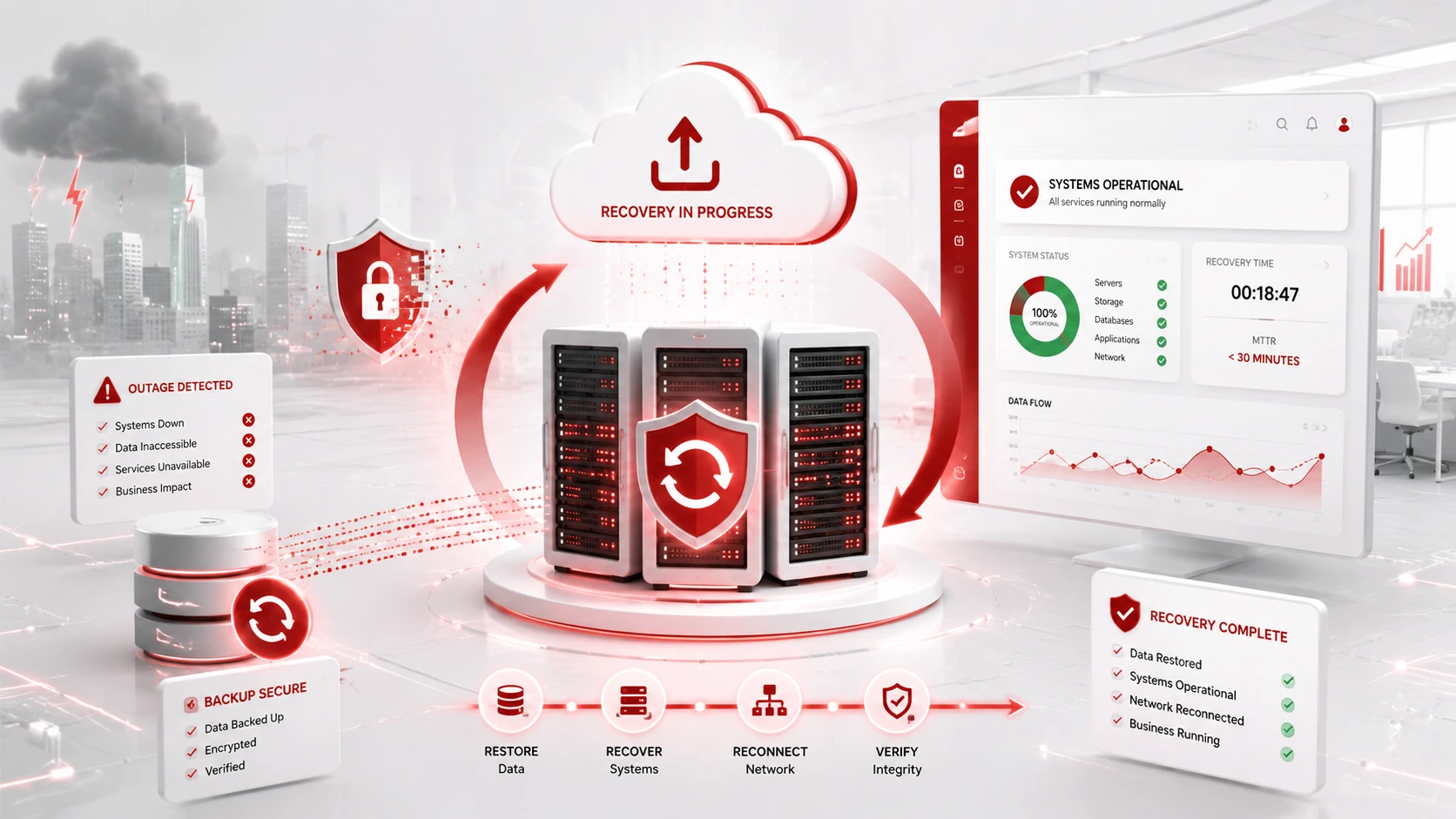
Imagine a ransomware attack locks important business files and prevents employees from accessing key systems.
The business continuity plan may cover:
- Who notifies employees
- How customers are updated
- Whether staff work remotely
- Which services continue manually
- Who approves emergency decisions
- How vendors or partners are contacted
The disaster recovery plan may cover:
- How affected systems are isolated
- Which backups are restored
- Which systems are recovered first
- How long recovery should take
- How data integrity is confirmed
- When systems can safely return to use
In this situation, business continuity keeps the company organized while disaster recovery focuses on restoring the technology.
Common Mistakes Businesses Make
Many businesses confuse business continuity and disaster recovery, or they create one plan and assume it covers everything.
Common mistakes include:
- Treating business continuity and disaster recovery as the same thing
- Only creating an IT recovery plan
- Not assigning clear responsibilities
- Not testing backups
- Not updating contact information
- Forgetting cloud applications
- Not planning employee or customer communication
- Waiting until an emergency to create the plan
The best plans are clear, current, and tested. A plan that has not been reviewed in years may not help when your business needs fast decisions.
How Often Should Businesses Review These Plans?
Businesses should review business continuity and disaster recovery plans at least once a year. They should also update them after major changes.
Review your plans when your business:
- Adds new systems or software
- Moves systems to the cloud
- Changes IT providers
- Moves office locations
- Adds remote employees
- Changes key vendors
- Experiences a cyber incident
- Grows into new departments or locations
Your plans should match how your business actually operates today. If your systems, employees, or workflows change, your continuity and recovery plans should change with them.
Which Plan Should You Create First?
Start with a business continuity plan if you need to define how your business will keep operating during a disruption. This helps you identify essential functions, key employees, communication needs, and operational priorities.
Start with a disaster recovery plan if your biggest concern is data loss, system downtime, ransomware, or technology failure.
In most cases, businesses should build both together. Business operations and technology are closely connected. If your technology goes down, your operations are affected. If your operations are disrupted, your technology recovery priorities may change.
Need Help Protecting Business Operations and Data?
Adivi helps businesses protect critical systems, strengthen backup processes, and create disaster recovery strategies that reduce downtime. If your business needs a stronger plan for outages, cyberattacks, or data loss, Adivi can help you prepare before disruption happens.
Schedule a free assessment with Adivi to strengthen your backup and disaster recovery strategy.
FAQs
What is the difference between business continuity and disaster recovery?
Business continuity focuses on keeping essential business operations running during a disruption. Disaster recovery focuses on restoring IT systems, data, and technology after a disruption.
Is disaster recovery part of business continuity?
Yes. Disaster recovery is usually part of a broader business continuity strategy because technology recovery supports business operations.
Does a small business need both a business continuity plan and a disaster recovery plan?
Yes. Small businesses need both because they must know how to keep operating and how to restore critical systems after an outage, cyberattack, or data loss event.
What should be included in a disaster recovery plan?
A disaster recovery plan should include critical systems, backup schedules, recovery goals, IT contacts, system recovery steps, and testing procedures.
What should be included in a business continuity plan?
A business continuity plan should include critical business functions, employee responsibilities, communication steps, vendor contacts, remote work procedures, and operational recovery priorities.
How often should business continuity and disaster recovery plans be tested?
Businesses should test these plans at least once a year, or more often if they handle sensitive data, rely heavily on technology, or experience major operational changes.