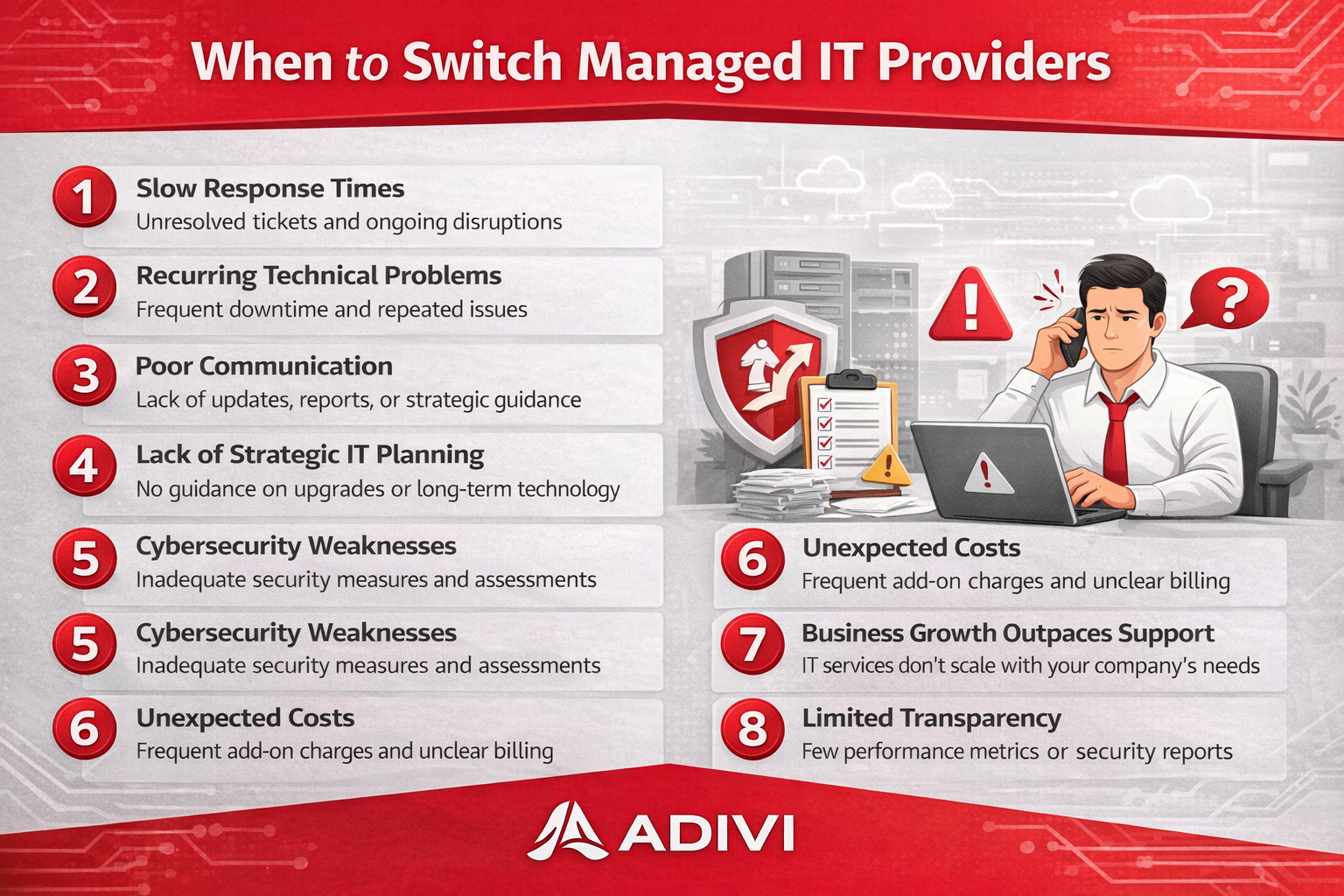
Your Managed IT provider should make your business stronger, safer, and more efficient, not stressed, reactive, or constantly troubleshooting.
But how do you know when it’s time to switch?
Changing IT providers is a big decision. However, staying with the wrong provider can cost your business far more in downtime, security risks, and missed growth opportunities.
Here’s how to recognize when it’s time to move on and what to consider before making the switch.
Key Takeaways
- Frequent downtime is a major red flag.
- Poor communication reduces trust and productivity.
- Weak cybersecurity increases business risk.
- IT providers should offer strategic planning, not just repairs.
- Unexpected fees and lack of transparency signal misalignment.
- Growth often requires upgrading to a more capable MSP.
1. Constant Downtime and Recurring Issues
If your systems frequently go down or the same problems keep happening, that’s a red flag.
A reliable Managed Service Provider (MSP) should focus on proactive maintenance rather than just fixing issues after they occur.
Warning signs include:
- Repeated server crashes
- Ongoing network slowness
- Recurring email or cloud access problems
- Long ticket resolution times
2. Poor Communication and Slow Response
IT issues are stressful enough. Lack of communication makes them worse.
If your provider:
- Takes hours (or days) to respond
- Doesn’t explain issues clearly
- Avoids transparency about problems
- Fails to provide regular reports
3. Weak Cybersecurity Protection
Cyber threats evolve daily. Your IT provider should stay ahead of them.
If your MSP:
- Doesn’t offer advanced endpoint protection
- Lacks multi-factor authentication (MFA)
- Has no ransomware response plan
- Doesn’t conduct regular risk assessments
4. Lack of Strategic IT Planning
IT should support business growth, not just keep systems running.
Ask yourself:
- Does your provider discuss long-term technology planning?
- Do they recommend upgrades before systems become outdated?
- Are they helping you scale effectively?
5. Unexpected or Rising Costs
Managed IT services should offer predictable pricing.
Red flags include:
- Surprise charges
- Frequent “extra” billing
- Unclear service scope
- Rising fees without added value
6. Your Business Has Outgrown Them
As companies grow, IT needs become more complex.
If your provider:
- Cannot support cloud migrations
- Struggles with compliance requirements
- Lacks 24/7 monitoring
- Doesn’t support hybrid or remote work environments
7. Compliance and Regulatory Gaps
If your industry requires compliance (e.g., finance, healthcare, e-commerce), your MSP must support those standards.
Frameworks like those from the National Institute of Standards and Technology and requirements such as Payment Card Industry Security Standards Council guidelines often require documented controls and regular assessments.
If your provider cannot demonstrate compliance readiness, your organization could face penalties.
What To Do Before Switching

Switching IT providers requires careful planning.
Here’s how to prepare:
✔ Review Your Contract
Check termination clauses, notice periods, and data ownership terms.
✔ Audit Your Current Environment
Ensure documentation of:
- Network configurations
- Admin credentials
- Licensing agreements
- Backup locations
✔ Evaluate New Providers Carefully
Ask about:
- Response times (SLAs)
- Security stack
- Onboarding process
- Client references
- Disaster recovery capabilities
Conclusion
Switching Managed IT providers is not an easy decision, but sometimes it’s necessary for business stability and growth.
Your IT partner should act as a strategic advisor, cybersecurity defender, and proactive problem-solver. If they are falling short in these areas, it may be time to explore better options.
Technology plays a critical role in modern business success. Choosing the right Managed IT provider ensures your systems are secure, scalable, and aligned with your long-term goals.
Don’t settle for reactive support; instead, try Adivi when proactive excellence is possible.